
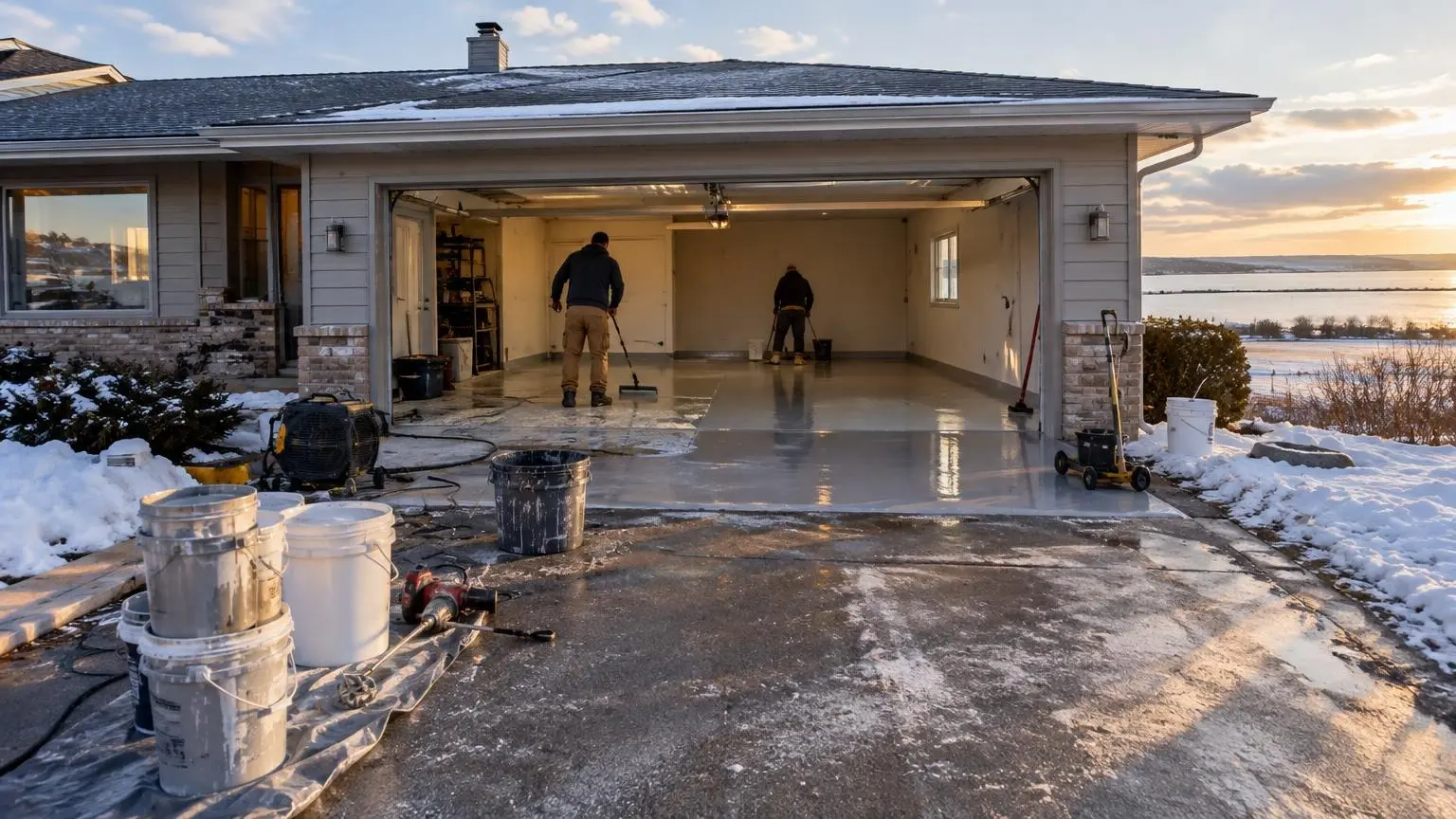
Concrete coatings for Brown County homes and shops
Epoxy Flooring in Green Bay, WI
Ground, repaired and coated floors made for 55 inches of snow a year and the salt that comes with it.
- Free on-site estimate with a slab moisture test
- Itemized written quote that lists every coat and prep step
- Whole floor diamond ground and repaired before coating
Coated Concrete for a Bay City Winter
Epoxy flooring in Green Bay has to survive a long, wet winter. Wikipedia puts the city's average snowfall at 55.6 inches a year, and the average January day tops out around 25.5°F. All that snow means plows and salt on every road, and the salty slush rides into your garage on the tires. Bare concrete soaks it up. A well-bonded coating keeps that brine on the surface so you can push it out the door.
Where the salt comes from
Salt is part of daily life here. Wikipedia lists it among the main cargoes at the Port of Green Bay, along with coal, limestone and cement, and the port moved 1.99 million tons of cargo in 2015. In winter, road salt shows up as white crust on garage floors from De Pere to Suamico. On an uncoated slab, repeated wetting, freezing and thawing with salty water loosens the top layer of concrete. You see it as flaking near the door, rough patches under the tires and a floor that sheds dust no matter how often you sweep. A garage floor coating stops that cycle at the surface.
Homes from every decade
Green Bay's housing spans more than a century. American Community Survey figures for 2019 to 2023, as summarized by Point2Homes, give a median year built of 1971. About 13.7% of homes went up before 1940, 15.5% in the 1950s and 17.3% in the 1970s, while only about 4.5% were built in 2010 or later. That means most garage and basement slabs we see here are several decades old. Some carry old paint, sealers or patches. Some have settled or cracked. Before we price a floor, we look for all of it, because two garages the same size can need very different prep. When you collect quotes from epoxy flooring contractors, ask each one to name the prep steps for your slab, not just the finish.
Humid air, cold slabs
Green Bay is humid. Wikipedia lists an annual average relative humidity of 72.8%, highest in fall and winter. The EPA suggests keeping indoor humidity below 60%, ideally 30 to 50%. Basement floors sit against cool ground, so in summer, humid air can condense on them, and moisture can also rise up through the slab from below. That vapor is the main reason basement coatings bubble or let go. We test before we recommend anything. Where moisture is present, we use a primer rated for it or tell you to fix the water source first.
Wisconsin's health department says about 1 in 10 homes in the state has high radon, and that radon enters through the foundation. Test kits run about $10 to $30. A floor coating is not a radon system, so if you plan to finish a basement, test first.
The systems we install
- Garage floor epoxy: a thick 100% solids base coat with a tough clear topcoat, the standard for attached and detached garages.
- Full-flake floors: vinyl flakes broadcast into the base until the floor is fully covered. They hide salt spots and add grip.
- Polyaspartic coatings: fast-curing and UV-stable, with a wider temperature window than epoxy. Useful in shoulder seasons and for same-week parking.
- Basement floor epoxy: systems matched to the moisture reading, for laundry rooms, rec rooms and storage spaces.
- Metallic epoxy: a poured, swirled finish for finished basements, bars and home gyms.
- Shop and commercial floors: heavier builds for trucks, forklifts, fluids and daily traffic.
Timing around the weather
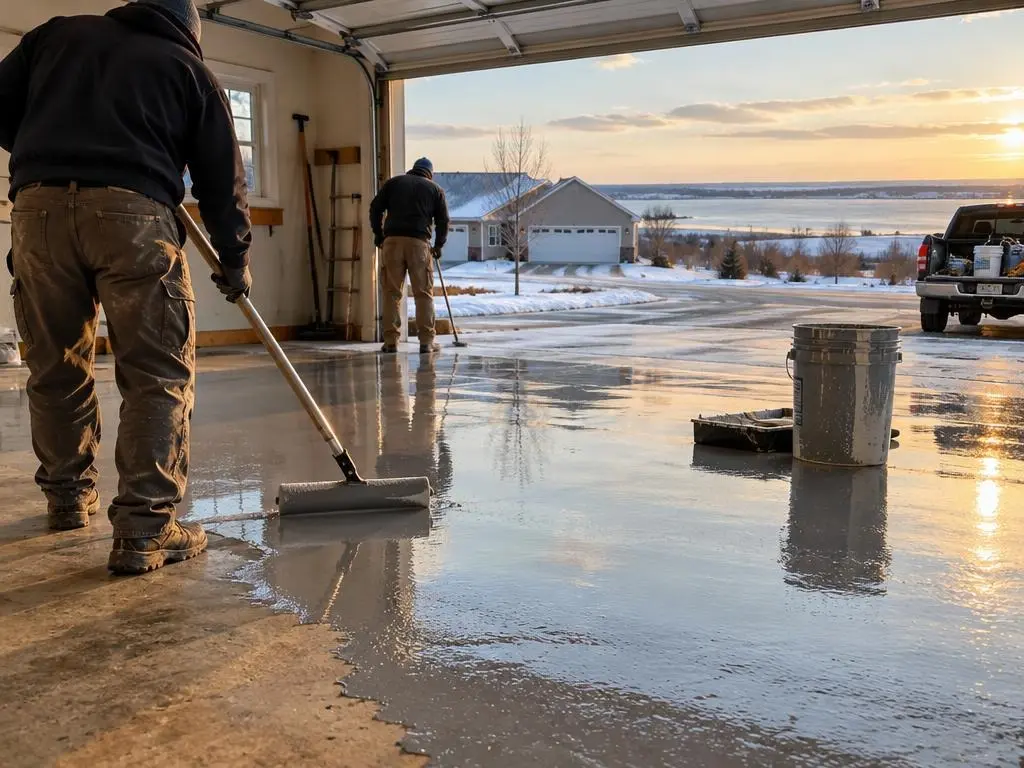
HomeGuide says epoxy should be applied between 60°F and 85°F with humidity under 85%, while polyaspartic can be applied across a far wider range. From late fall into spring, an unheated Green Bay garage is often below that epoxy range. We check the slab temperature, can heat the space, and lean on polyaspartic topcoats when the cold is the limiting factor. If a day is wrong for the product, we reschedule.
Why Homeowners Call Green Bay Epoxy Flooring
Grinding before any coating
Every slab is diamond ground edge to edge so the coating bonds to sound concrete, with salt-damaged surface removed.
A moisture reading on every job
We test garage and basement slabs before quoting, so the primer and system fit the floor.
Built for brine and cold
Seamless, chemical-resistant topcoats and textured finishes keep winter slush on top and footing secure.
A written price you can hold us to
The quote spells out square footage, prep, each coat and the total. Changes are written and approved by you first.
Common Questions
How much does it cost to epoxy 1,000 square feet?
At HomeGuide's national range of $4 to $10 per square foot installed, 1,000 square feet comes to about $4,000 to $10,000 for epoxy. Polyaspartic runs $5 to $12 per square foot on HomeGuide, or about $5,000 to $12,000. Heavy prep, such as grinding off an old coating or repairing salt scaling, can push a Green Bay floor toward the top of that range.
How much does a 12x12 epoxy floor cost?
A 12x12 floor is 144 square feet. At $4 to $10 per square foot, that is roughly $576 to $1,440. Small floors often cost more per square foot, because setup, grinding and travel take nearly as long as they do on a larger room.
What is the downside of epoxy flooring?
HomeGuide lists hard application, long cure times and brittleness in extreme temperatures. Standard epoxy can also yellow in sunlight and gets slippery when wet if it is left glossy and smooth. Good prep, a UV-stable topcoat and added texture handle most of these.
Is it expensive to epoxy your floor?
HomeAdvisor puts the average garage coating job at about $2,526, with most falling between $1,650 and $3,494. Store kits cost far less, about $200 to $700 per HomeGuide, but they usually depend on acid etching and thin coats. On a slab that takes Wisconsin road salt every winter, that is often the one that has to be redone.
Can you install an epoxy floor in a Green Bay winter?
Yes, with care. Epoxy needs a warm slab to cure, and HomeGuide gives 60°F to 85°F as its application range. In cold months we heat the space, check the slab temperature, and often use polyaspartic, which has a much wider temperature window. If we cannot get conditions right, we pick another date.
Does an epoxy floor coating work on a lakeshore garage in Kewaunee or Algoma?
Yes, with the same prep we use in Green Bay. The Lake Michigan towns share the humid air and the salted roads, so we test the slab for moisture, grind it, and use a chemical-resistant topcoat with texture. A detached garage near the water can stay cold and damp into spring, so we check slab temperature before scheduling.
How long does a coated garage floor last?
HomeGuide says water-based epoxy may last 3 to 5 years, while solid epoxy and polyaspartic systems last 10 to 20 years or more. In a snowbelt garage, the prep, the thickness of the system and how often you rinse salt off the floor make the biggest difference.
Will my coated floor be slick when it is wet with snowmelt?
A smooth, glossy finish can be. Flake floors have built-in texture, and we can mix an anti-slip aggregate into the topcoat on solid-color floors. Most garage customers here choose one or the other.
Our Epoxy Flooring Services
Six concrete coating services matched to Northeast Wisconsin garages, basements and work floors.
Garage Floor Epoxy
Ground, repaired and coated garage slabs that hold up to a Brown County salt season.
Learn more →Full-Flake Epoxy Floors
Vinyl flake broadcast floors that hide salt spots, add grip and come in dozens of color blends.
Learn more →Polyaspartic Floor Coatings
Fast-curing, UV-stable coatings with a wide temperature window, useful in shoulder seasons and busy households.
Learn more →Basement Floor Epoxy
Moisture-tested basement coatings for laundry rooms, rec rooms and storage areas in older and newer homes.
Learn more →Metallic Epoxy Floors
Poured, swirled metallic finishes for finished basements, bars, gyms and other rooms where looks lead.
Learn more →Shop & Commercial Floor Epoxy
Heavier coating systems for shops, warehouses, truck bays and commercial floors in Brown County.
Learn more →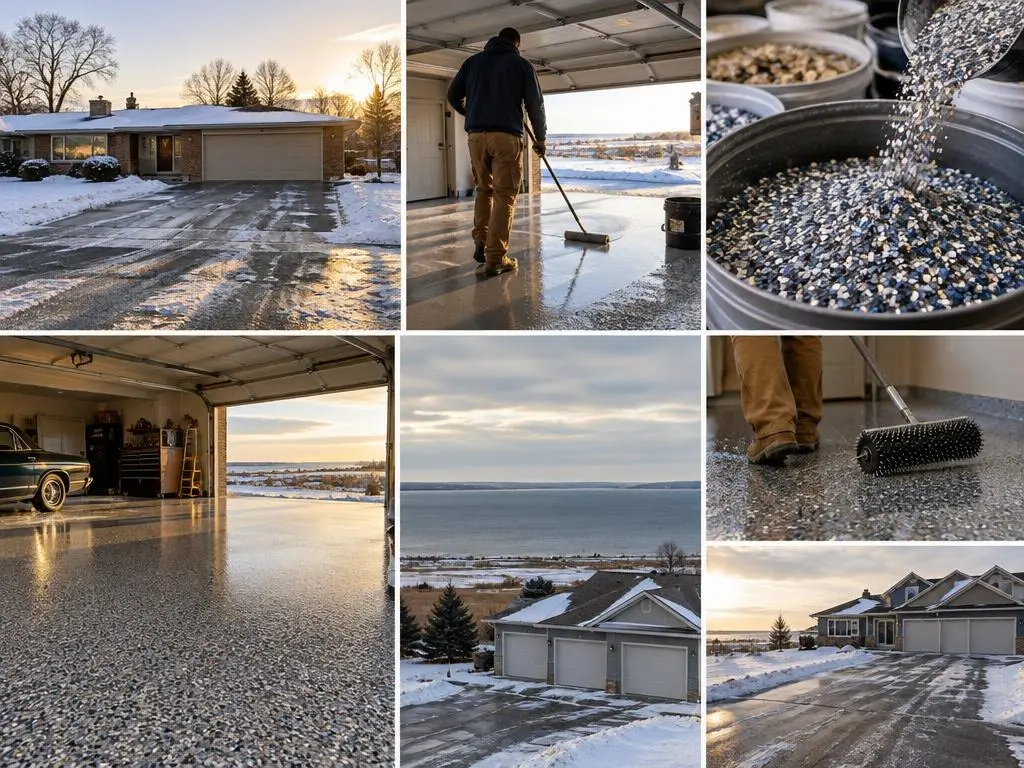
Where We Work
We are based around Green Bay and cover the rest of Brown County plus the towns north and east along the bay. That includes De Pere, Ashwaubenon, Allouez, Bellevue, Howard, Suamico, Hobart, Ledgeview, Lawrence, Scott, Humboldt, Denmark, Pulaski, Wrightstown and Greenleaf, with trips out to Seymour, Little Suamico, Oconto, Luxemburg, Kewaunee and Algoma. The floors change as you move out from the city. In Green Bay itself, about a third of homes were built before 1960, so we see plenty of older, patched slabs. Suamico, by contrast, has mostly developed since 1980, and its garages tend to be newer and larger. Lakeshore towns like Kewaunee and Algoma sit right on Lake Michigan. Our epoxy installers handle the newer Suamico garages and the older patched floors in the city the same way: test, grind, repair, then coat. Each town page covers what we know about the homes there.
- Epoxy Flooring in Green Bay, WI
- Epoxy Flooring in De Pere, WI
- Epoxy Flooring in Ashwaubenon, WI
- Epoxy Flooring in Allouez, WI
- Epoxy Flooring in Bellevue, WI
- Epoxy Flooring in Howard, WI
- Epoxy Flooring in Suamico, WI
- Epoxy Flooring in Hobart, WI
- Epoxy Flooring in Ledgeview, WI
- Epoxy Flooring in Lawrence, WI
- Epoxy Flooring in Scott, WI
- Epoxy Flooring in Humboldt, WI
- Epoxy Flooring in Denmark, WI
- Epoxy Flooring in Pulaski, WI
- Epoxy Flooring in Wrightstown, WI
- Epoxy Flooring in Greenleaf, WI
- Epoxy Flooring in Seymour, WI
- Epoxy Flooring in Little Suamico, WI
- Epoxy Flooring in Oconto, WI
- Epoxy Flooring in Luxemburg, WI
- Epoxy Flooring in Kewaunee, WI
- Epoxy Flooring in Algoma, WI
Get an Epoxy Flooring Estimate
Free on-site estimates in Green Bay and across Brown County.